Skip to content

MedSafe Drug Collection Kiosk

MedSafe combines a stainless-steel collection receptacle with a removable prepaid shipback inner liner. When the inner liner fills, authorized persons can safely remove the liner from the collection receptacle, seal it, and return it via common carrier. Inner lines are treated by incineration, rendering the pharmaceuticals non-retrievable per the DEA’s destruction standard.

Masthead inner graphic. Innerpage header background.

A secure place for unused medications, at the pharmacies, hospitals, and long-term care communities people trust.

MedSafe is an unused and expired medication disposal system. This easy-to-operate system accepts controlled (Schedules II-V), non-controlled, and over-the-counter medicines. MedSafe meets the requirements of the DEA Controlled Substances Act. Patients and families deposit unused medications. When the liner is full, it’s sealed, shipped back on a prepaid label, and destroyed by incineration.

Request a Quote


Find Your Industry

Retail and community pharmacy Give patients a disposal option at your counter. See pharmacy details →

Hospitals and health systems Offer patients and families a collection point on campus. See hospital details →

Long-term care Handle discontinued resident medications with your pharmacy partner. See long-term care details →

Police, sheriff & fire Offer residents year-round disposal, or connect them to it. See public safety details →

Why Medication Collection Matters

Unused medications pile up in homes. A course of pain medication ends early. A prescription changes. A family member passes away and leaves a cabinet full of bottles.

Most people don’t know what to do with them, so they ask the pharmacist, the discharge nurse, or the front desk at a senior living community. When there’s no good answer, medications stay in the house, go in the trash, or get flushed.

A collection receptacle gives those questions a clear answer, at a place people already visit. For the organization that hosts it, the program is a visible service to patients, residents, families, and the surrounding community.

medsafe-header

MedSafe Benefits

  • Cost-effective and easy-to-manage system that meets DEA regulations
  • Comingled collection of controlled and non-controlled pharmaceuticals
  • Inner liners transferred by a common carrier
  • Controlled drugs destroyed using incineration, meeting the DEA’s destruction standard of non-retrievability

MedSafe Features

  • 14-gauge powder-coated steel collection receptacle
  • One-way medicine drop with locking door
  • Double-locked front door access
  • Secures to a permanent structure
  • Serialized liners with prepaid common carrier return

How MedSafe Works

MedSafe is designed to meet DEA collection receptacle requirements. The organization that runs the program, known as the collector, is responsible for its DEA registration, where the receptacle is placed, and how liners are handled.

Medications are deposited.
The liner fills.
The liner is sealed and shipped.
Medications are destroyed.

Medications are deposited.

Patients, families, or authorized staff place unused medications in the one-way drop. Controlled and non-controlled medications can go in together. Nothing is counted, sorted, or inventoried after it’s deposited.

The liner fills.

Medications collect in a removable, serialized inner liner inside a locked, 14-gauge powder-coated steel receptacle secured to a permanent structure.

The liner is sealed and shipped.

Authorized persons remove and seal the full liner and return it by common carrier on its prepaid label. A new liner goes in.

Medications are destroyed.

Liners are treated by incineration, which renders the pharmaceuticals non-retrievable under the DEA’s destruction standard.

Retail & Community Pharmacy

Answer the question patients bring to your counter

Pharmacists hear it often: What do I do with these? A MedSafe receptacle gives patients a place to leave unused medications, including controlled substances, at the pharmacy they already visit.

Why Pharmacies Host MedSafe
What the Rules Require at a Pharmacy
Hosting MedSafe at your Pharmacy
Woman-using-medication-disposal-kiosk-e1789671834854

Why Pharmacies Host MedSafe

Why Pharmacies Host MedSafe

  • Patients come to you to use it. Federal rules place the receptacle near the pharmacy counter, so every disposal visit brings a patient to your pharmacy.
  • A service your community can see. Hosts receive postcards, flyers, and posters to let patients know the program is available.
  • Liners go back when they’re full. Sealed liners return by common carrier on a prepaid label, with no pickup appointment to plan around.
Medsafe-label-e1789671865575

What the Rules Require at a Pharmacy

What the Rules Require at a Pharmacy

Collecting is voluntary. A retail pharmacy that chooses to collect modifies its DEA registration to become an authorized collector. Once it does:

  • The receptacle is placed inside the pharmacy, near where controlled substances are stored and where an employee is present, such as within view of the pharmacy counter.
  • It’s fastened to a permanent structure, locked, and has an opening that allows deposits but not removal.
  • The deposit opening is locked when the pharmacy is closed.
  • Signage shows which substances are accepted.
  • Patients deposit their own medications. Staff can’t accept medications from a patient for disposal.
  • Two pharmacy employees handle installing and removing the inner liner.
Medsafe-Sizes-e1789671902433

Hosting MedSafe at your Pharmacy

Hosting MedSafe at your Pharmacy

Recommended size: The 38-Gallon MedSafe is designed for facilities such as retail pharmacies that collect larger amounts of medication from patients. Smaller-volume pharmacies may prefer the 18-Gallon MedSafe. See specifications

Staff time: Monitoring the receptacle during open hours, locking the opening at close, and changing the liner when it’s full.

What staff don’t do: Count, sort, or log what patients deposit.

Multi-location pharmacies: We can review locations together and help identify where a receptacle fits best.

  • Patients deposit their own medications. Staff can’t accept medications from a patient for disposal.
  • Two pharmacy employees handle installing and removing the inner liner.

Request a Quote

Download the 38-Gallon spec sheet


Hospitals & Health Systems

Give patients and families a place to dispose of medications on campus

Patients leave the hospital with medications they won’t finish. Families clear out a relative’s medications after a death or a move to care. Hospitals and clinics with an on-site pharmacy can offer a MedSafe receptacle so those medications have somewhere safe to go.

Why Hospitals Host MedSafe
What the Rules Require at a Hospital
Where a Receptacle Can Go
Medsafe_Hospital-e1789673607381

Why Hospitals Host MedSafe

Why Hospitals Host MedSafe

  • Discharge counseling has a clear answer. Staff can point patients and families to a specific place on campus.
  • A visible community health service. A receptacle in a staffed public area shows patients and visitors the hospital’s role in medication safety.
  • One vendor for more than one waste stream. Sharps MWS also provides pharmaceutical, controlled substance, and regulated medical waste services for hospital operations. View related services
Medsafe-label-e1789671865575

What the Rules Require at a Hospital

What the Rules Require at a Hospital

Hospitals and clinics with an on-site pharmacy may choose to collect by modifying the pharmacy’s DEA registration to become an authorized collector. Once registered:

  • Only medications lawfully held by patients and other authorized non-registrants may be collected. Controlled and non-controlled medications may be combined.
  • Deposited medications aren’t counted, sorted, or inventoried.
  • Two employees of the collector install and remove the inner liner.

A collection receptacle is for patient medications only. Hospital inventory, expired stock, and doses wasted at the point of care go through the hospital’s pharmaceutical waste, controlled substance waste, or reverse distribution process. Pharmaceutical Waste Disposal · Controlled Substances Waste Disposal

Medsafe-Sizes-e1789671902433

Where a Receptacle Can Go

Where a Receptacle Can Go

Hospital placement rules differ from pharmacy rules. The receptacle must be:

  • In an area regularly monitored by employees
  • Not near any area where emergency or urgent care is provided
  • Locked or inaccessible when the area isn’t being monitored
  • Fastened to a permanent structure

Request a Quote

Download the 38-Gallon spec sheet


Long-term Care Facilities

Handle discontinued resident medications without the extra steps

Every long-term care community ends up with medications no one will take: after a death, a transfer to another level of care, a discontinued order, or a family clearing out an apartment. MedSafe gives skilled nursing and assisted living communities a secure receptacle for those medications, managed with the community’s pharmacy partner, where allowed.

Why Long-term Care Communities Use MedSafe
What the Rules Require in Long-term Care
Your Pharmacy Partner's Role
Medsafe_LTC-e1789673537493

Why Long-term Care Communities Use MedSafe

Why Long-term Care Communities Use MedSafe

  • Fewer steps for nursing and med staff. Staff no longer have to spend time mixing unused medications with kitty litter or popping pills out of bingo cards.
  • Controlled and non-controlled medications together. One receptacle for both.
  • A consistent answer for families. Staff can direct resident medications to one place instead of improvising at a difficult moment. 
  • The same process across communities. Operators with multiple communities can use one approach everywhere MedSafe is permitted.
Medsafe-label-e1789671865575

What the Rules Require in Long-term Care

What the Rules Require at a Hospital

  • Only an authorized retail pharmacy or a hospital/clinic with an on-site pharmacy may install, manage, and maintain a receptacle at a long-term care facility.
  • The community may dispose of a current or former resident’s controlled substances by placing them in the receptacle. This must happen promptly, and no later than three business days after use is discontinued, including discontinuation due to a transfer or death.
  • The receptacle must be in a secured area regularly monitored by the community’s employees, and locked when it isn’t being monitored.
  • Liner installation and removal is done by one employee of the pharmacy partner and one supervisor-level community employee designated by the pharmacy (such as a charge nurse), or by two pharmacy employees.
  • Sealed liners may be stored at the community for up to three business days in a locked cabinet or locked room with controlled access.

State rules also apply and vary. Eligibility should be confirmed for each state.

Medsafe-Sizes-e1789671902433

Your Pharmacy Partner's Role

Your Pharmacy Partner’s Role

Because a pharmacy must manage the receptacle, the conversation with your pharmacy provider usually comes first.

Your pharmacy partner:

  • Registers with the DEA as a collector, if it isn’t already
  • Installs and maintains the receptacle at your community
  • Handles or supervises liner removal, replacement, storage, and transfer

Your community:

  • Provides a secured, monitored location
  • Designates a supervisor-level employee for liner changes, if that model is used

Sharps MWS works with long-term care communities and their pharmacy partners to set up the program.

Request a Quote

Download the 38-Gallon spec sheet

Download the 18-Gallon spec sheet


Public Safety

Year-round medication disposal for the communities you serve

Residents bring unused medications to police departments, sheriff’s offices, and fire stations throughout the year, not just on Take Back Day. What an agency can do with them depends on whether it’s law enforcement or fire and EMS.

Police departments and sheriff’s offices can host MedSafe directly. Residents deposit medications, including controlled substances, anonymously any time your lobby is open. When the liner is full, staff seal it and ship it for destruction instead of emptying, storing, and transporting loose contents.

DEA recommends that law enforcement transferring collected substances for destruction record the liner’s unique ID and size, the transfer date, and the recipient’s name, address, and registration number. The EPA recommends incineration over landfilling for household medications collected by law enforcement.

Fire stations are open, staffed, and trusted, so residents often bring medications and used needles there. Fire departments aren’t authorized under federal rules to collect controlled substances, so a station can’t take them or host a receptacle that collects them. A police department’s receptacle must be inside a law enforcement location, so it can’t be placed at a fire station either.

Medications that belong to your agency, including expired EMS stock, wasted doses, and controlled substances from your EMS program, are a separate waste stream from resident disposal. Sharps provides controlled substance wastepharmaceutical waste, and regulated medical waste services for EMS operations.


Narcotic treatment programs

MedSafe is also designed for narcotic treatment programs. Contact our team to discuss requirements for your setting.

MedSafe Specifications

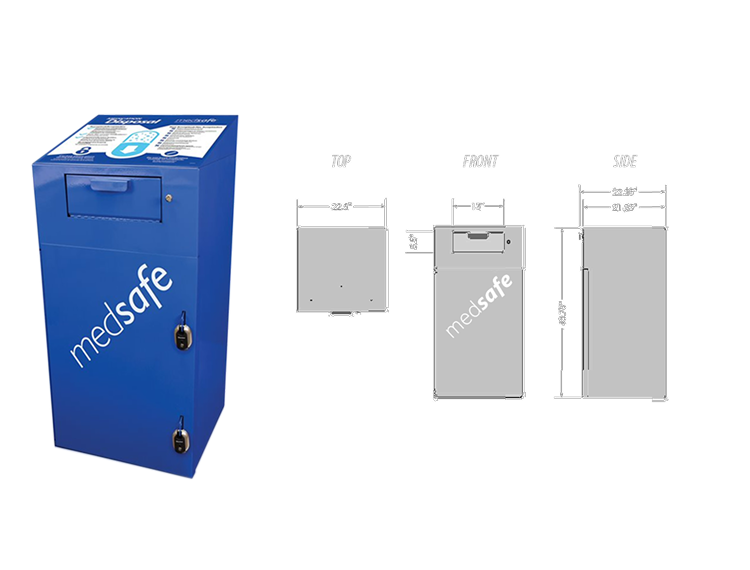
38-Gallon MedSafe
18-Gallon MedSafe

38-Gallon MedSafe

38-Gallon MedSafe is ideal for facilities, such as retail pharmacies, that generate larger amounts of pharmaceutical waste from ultimate users. MedSafe increases foot traffic for retail pharmacies by providing a much-needed service to the community.

MedSafe 38-Gallon Collection Receptacle Specifications

  • Overall Dimensions: 43.75″ x 22.5″ x 21.25″
  • Top Opening Dimensions: 5.5″ x 13″

38-Gallon Inner Liner Specifications

  • Constructed of two 200# Test Corrugated Fiberboard Enclosures
  • Outer Box Dimensions: 18.25″ x 18.25″ x 27″
  • Inner Box Dimensions: 17.75″ x 17.75″ x 26.375″
  • Two 4-Mil Polyethylene Plastic Bags
  • Eighteen 4″ x 6″ Absorbent Pads
Frame-4

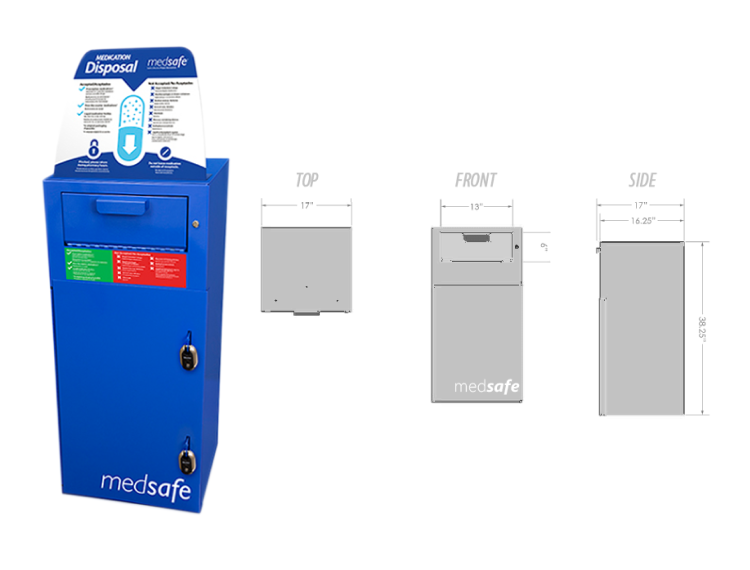
18-Gallon MedSafe

18-Gallon MedSafe is perfect for facilities that generate smaller amounts of pharmaceutical waste, such as long-term care facilities. MedSafe is convenient and easy to use. Nurses no longer have to spend time mixing unused medication with kitty litter or popping pills out of bingo cards.

MedSafe 18-Gallon Collection Receptacle Specifications

  • Overall Dimensions: 38.25″ x 17″ x 16.25″
  • Top Opening Dimensions: 5.5″ x 13″

18-Gallon Inner Liner Specifications

  • Constructed of two 200# Test Corrugated Fiberboard Enclosures
  • Outer Box Size: 13.5″ x 13.5″ x 22.5″
  • Inner Box Size: 13″ x 13″ x 22″
  • Two 4-Mil Polyethylene Plastic Bags
  • Ten 4″ x 6″ Absorbent Pads
Frame-5

MedSafe FAQs

Sharps Compliance, Inc. (Sharps) fully complies with DOT regulations for the transport of such drugs collected for disposal as authorized by the DOT under Special Permit # DOT-SP 20284. Click the link for the Special Permit under which the Company operates.


MedSafe is designed for long-term care facilities (LTCF), licensed law enforcement, and narcotic treatment centers, as well as retail pharmacies and hospitals and clinics with on-site pharmacies. When used in long-term care, an approved “collector” must manage the MedSafe collection receptacle program.

A collector is an approved DEA registrant that applies with the DEA to collect controlled substances from ultimate users. Retail pharmacies can install and manage a MedSafe collection receptacle program by registering with the DEA as a collector. Additionally, retail pharmacies may install and manage MedSafe programs at LTCFs.

Yes. Both controlled (Schedules II-V) and non-controlled substances can be disposed of in the MedSafe collection receptacle. With MedSafe, facilities have one complete solution for disposal of non-hazardous unused medications.

The MedSafe medication collection and disposal systems is available for sale or lease to facilities approved by the DEA to manage collection receptacle programs. For more information on each option and pricing, please contact a Sharps Compliance sales consultant at 888.364.9201.

Inner liners are available for purchase in a four-pack option or they are auto-shipped when the MedSafe system is leased. Pricing is dependent on program purchaselease options. To learn more about MedSafe and which option best meets your facility’s needs, please contact a Sharps Compliance sales consultant at 888.364.9201.

A link to the full regulations is here. You can access links for DEA registrants, LTCFs and more here. DEA login page for CSA collector status request or update.

Sharps Compliance has created materials to help you market MedSafe to your community. You will have access to postcards, flyers, posters, and much more so you can spread the word about MedSafe.

MedSafe In The News 

Deseret News
Army Flier
Northwest Florida Daily News
Aspirus Iron River Hospital
Aspirus Iron River Hospital Pharmacist

Deseret News

That is until now. At nearly two dozen of its community pharmacies across the state, Intermountain Healthcare has installed secure drop-off boxes called “MedSafe.” Utah is one of a few states in the nation installing these. People who have unused medications can deposit them in the boxes for proper disposal.

Army Flier

In an effort to improve safety among the Fort Rucker community, Lyster Army Health Clinic added a new option for medication disposal for its beneficiaries. Located in the pharmacy lobby, the new MedSafe drop box allows patients to safely dispose of any unwanted or expired medications.

Northwest Florida Daily News

By law, the pharmacy could not legally accept dispensed prescriptions. That changed last fall,” said Maj. Marc Fletes, director of outpatient pharmacy operations here. “The MEDSAFE unit definitely meets our patients’ needs.

Aspirus Iron River Hospital

In an effort to improve safety in Iron County related to medication disposal, Aspirus Iron River Hospital & Clinics has provided a grant for two drug disposal receptacles in the community.

Aspirus Iron River Hospital Pharmacist

It’s important to properly dispose of unused medications to reduce the risk of accidental exposure or intentional misuse.” Aspirus Iron River Hospital Pharmacist.

homepage-header

Contact Us Today to Get Started with MedSafe

Market Leading Ultimate-User Medication Disposal Solution

Request a Quote

cta-texture
Request A Quote