February 2, 2026 Sharps Medical Waste Services Appoints David Sanborn as Chief Operating Officer Veteran operations executive with 25+ years of leadership experience, supports national growth, safety, and compliance excellence at the medical waste company. HOUSTON, Texas – Sharps Medical Waste Services (MWS), a national leader in regulated medical waste management, announced the appointment of David Sanborn as Chief Operating Officer, effective January 26. Sanborn will report directly to Chief Executive Officer Kerry Jones and will oversee Sharps’ nationwide operations as the company continues to scale its services, strengthen execution, and advance its commitment to safety, compliance, and public health protection. Sanborn brings more than 25 years of operations leadership experience across complex, multi-site environments, including manufacturing, distribution, and highly regulated industries. Most recently, he served as Vice President of U.S. Operations at Reddy Ice, where he led operations across more than 130 facilities in 32 states, with full P&L responsibility and oversight of more than 1,600 team members. His background includes driving operational consistency at scale, improving safety and service performance, integrating acquisitions, and building disciplined operating models that support sustainable growth. “This appointment comes at a pivotal moment for Sharps,” said Kerry Jones, Chief Executive Officer of Sharps Medical Waste Services. “As we continue to grow nationally, operational discipline, safety leadership, and regulatory excellence are more important than ever. David has a proven track record of leading large, distributed operations while improving safety outcomes and delivering consistent performance. His leadership will be instrumental as we support our customers and protect the communities we serve.” Throughout his career, Sanborn has led organizations through periods of scale and transformation, with a strong emphasis on safety culture, workforce development, and operational accountability. “As Chief Operating Officer, my focus is on building consistent, reliable operations that put safety and compliance first,” said David Sanborn. “Sharps plays a critical role in protecting healthcare workers, patients, and communities. I’m looking forward to working alongside the team to strengthen execution, support growth, and ensure our operations continue to meet the highest standards across every market we serve.” In his role, Sanborn will focus on driving operational consistency across Sharps MWS’ national footprint, supporting profitable and sustainable growth, and ensuring teams are equipped with the structure, tools, and leadership needed to perform in a highly regulated healthcare services environment. — About Sharps Medical Waste Services Sharps Medical Waste Services (MWS) is a leading, U.S.-based provider of regulated medical waste management and compliance solutions, serving healthcare facilities, pharmacies, laboratories, and businesses nationwide. The company is committed to protecting public health through safe, compliant, and reliable waste handling services, supported by rigorous regulatory standards, operational excellence, and a customer-focused service model. For more information, please visit sharpsmws.com. Media Inquiries (281) 901-7619 [email protected] Read More
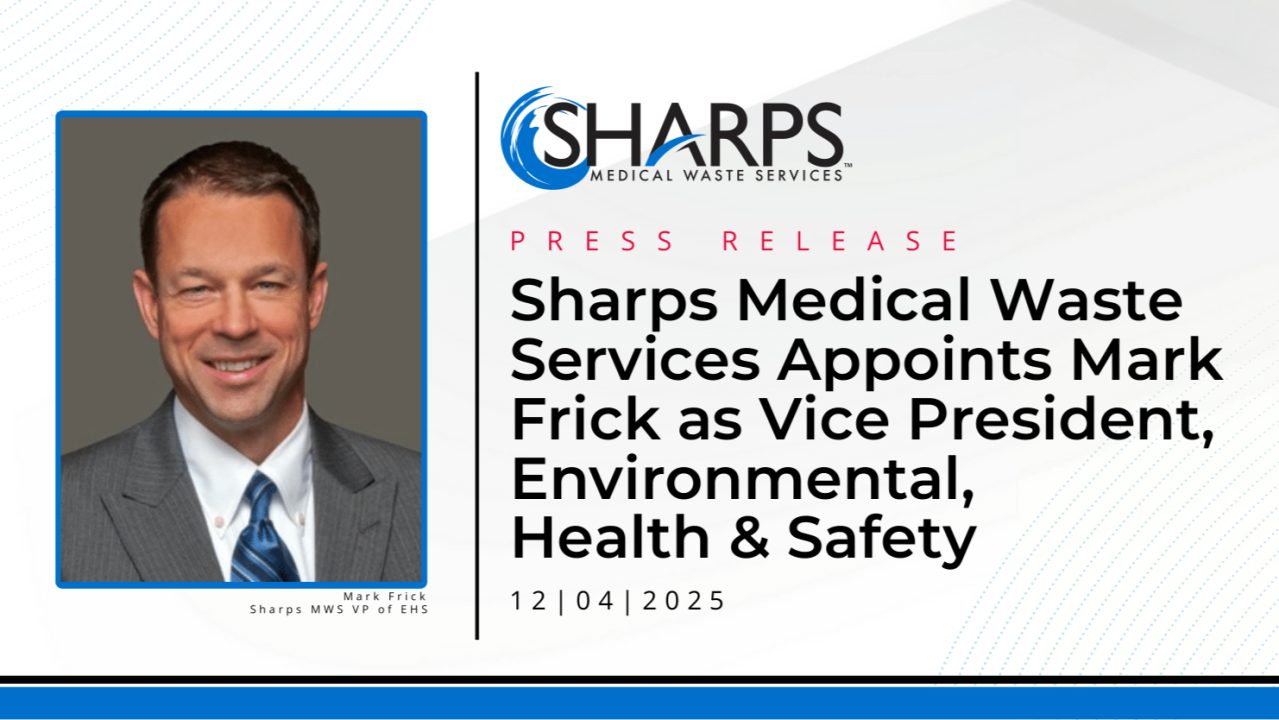
December 4, 2025 Sharps Medical Waste Services Appoints Mark Frick as Vice President, Environmental, Health & Safety HOUSTON, Texas – Sharps Medical Waste Services (MWS), a leading provider of regulated medical waste management and compliance-driven environmental solutions, announces the appointment of Mark Frick as Vice President, Environmental, Health & Safety (EHS). In this role, Mark will oversee the company’s EHS strategy and programs across its U.S. operations and will report directly to Chief Executive Officer Kerry Jones. With Safety First at the heart of our culture, Mark’s leadership and expertise make him the ideal choice to guide this important initiative. Mark brings more than 35 years of global EHS leadership experience across high-hazard, highly regulated industries, including the medical waste industry. He has built a distinguished career driving transformative safety performance, strengthening compliance systems, and fostering resilient, prevention-focused safety cultures. Mark holds a Master of Science degree in Environmental Engineering from the Illinois Institute of Technology and a Bachelor of Science degree in Chemical Engineering from the University of Houston. “We are pleased to welcome Mark to Sharps,” said Kerry Jones, Chief Executive Officer, Sharps Medical Waste Services. “His deep industry expertise, proven record of elevating safety performance, and strong leadership approach align with our mission and values. Mark’s contributions will be instrumental as we continue strengthening our safety culture and delivering excellence for our customers, our employees, and the communities we serve.” Mark added, “I am honored to join Sharps at such a pivotal time in the company’s exponential growth. I look forward to partnering with our operations teams across the U.S. to advance a proactive, prevention-driven safety culture and build on the strong foundation already in place.” — About Sharps Medical Waste Services Sharps Medical Waste Services (MWS) is a leading, U.S.-based provider of regulated medical waste management and compliance solutions, serving healthcare facilities, pharmacies, laboratories, and businesses nationwide. The company is committed to protecting public health through safe, compliant, and reliable waste handling services, supported by rigorous regulatory standards, operational excellence, and a customer-focused service model. For more information, please visit sharpsmws.com. Media Inquiries (281) 901-7619 [email protected] Read More
April 20, 2016 Recycling Single-Use Medical Devices Does your facility reprocess single-use medical devices (SUDs)? Did you know that reprocessing SUDs can carry risks and disadvantages? Healthcare facilities are becoming more concerned about reprocessing SUDs (devices intended for one use or use on a single patient during a single procedure). Studies have found a significant rate of physical defects, performance issues, or improper decontamination associated with reprocessing of SUDs. According to the American Congress of Obstetrics and Gynecology, “The use of a reprocessed single-use device provides no direct benefit to an individual patient or her physician.”1 SUDs are not designed with reuse in mind. Reprocessing SUDs can increase potential for patient infection. Reprocessed SUDs are often disassembled and parts are exchanged, resulting in compromised functionality of the devices. Common materials used in SUDs are often a combination of metals and plastic, which is difficult to sterilize without causing changes to the materials. These changes may result in an inability to validate the devices for reuse. Cost-savings and environmental concerns have led to the practice of single-use medical device reprocessing. However, with increased focus on patient-centered care and accountability, recycling is quickly becoming the preferred method of management for SUDs. Sharps Compliance offers the TakeAway Recycle System for the safe collection, storage, transport, and recycling of SUDs. This cost-effective solution allows organizations to reduce risk while addressing environmental concerns. Almost all single-use medical devices are composed of materials that can be recycled. Using the TakeAway Recycle System ensures that all of the collected materials are processed down to their basic commodities. SUDs that are normally destined for reprocessing, the landfill, or treatment as medical waste are collected in the operating room or sterile processing department and then shipped by common carrier for recycling. TakeAway Recycle System helps you avoid liability by controlling potential infection caused by reprocessed SUDs. It also saves you money by eliminating the cost and pitfalls of reprocessed SUDs. This system is compliant with OSHA and DOT and complements your sustainability initiatives. 1“Reprocessed Single-Use Devices.” The American College of Obstetricians and Gynecologists. Number 537, October 2012 Read More
May 26, 2015 COVID-19 Medical Waste: Helpful Tips Last updated on September 29, 2021 This is an update of the article originally published on March 19, 2020. Regulations change frequently. That’s why Sharps Compliance monitors updates and communicates any changes to its customers. In these uncertain times, many of our current and prospective customers look to us, their regulated medical waste (RMW) management experts, for guidance in the proper handling of waste generated from confirmed and suspected COVID-19 cases, and rightfully so. As a courtesy to anyone seeking out such guidance, we have created a list of recommendations for waste management in some of the industries most impacted by coronavirus. All guidance listed below reflects the most up-to-date recommendations issued by the Centers for Disease Control (CDC), the World Health Organization (WHO), and industry leaders, as of April 10, 2020. And though the general recommendation is to treat COVID-19 RMW the same as any other infectious waste, there are some specific tips below that may prove useful to your home or practice. Healthcare, general: CDC’s Guidelines for Caring for Patients: Management of medical waste should be performed in accordance with routine procedures. CDC’s Infection Control Recommendations: Facilities should provide tissues and no-touch receptacles for disposal, at healthcare facility entrances, waiting rooms, and patient check-ins. Healthcare professionals must receive training on and demonstrate an understanding of how to properly dispose of or disinfect and maintain PPE. CDC’s guidance states that management of laundry, food service utensils, and medical waste should be performed in accordance with routine procedures. Discard disposable PPE after exiting patient’s room or care area and closing the door unless implementing extended use or reuse. From OSHA’s “Guidance on Preparing Workplaces for COVID-19”: N95 respirator training should address proper disposal. Workers who dispose of PPE and other infectious waste must also be trained and provided with appropriate PPE. Per the American Association of Bronchology & Interventional Pulmonology: Disposable bronchoscopes should be used first line when available. Follow CDC instructions for proper donning and doffing of all protective equipment and disposable devices. This information is based on the latest Centers for Disease Control (CDC) recommendations and expert consensus of the AABIP COVID-19 Task Force. Family Medicine Clinics: American Academy of Family Physicians’ Checklist to Prepare Physician Offices for COVID-19: No-touch containers with disposable liners should be placed in all reception, waiting, patient care, and restroom areas used to dispose of waste materials with respiratory secretions. Arrange to use the currently recommended routine procedures/methods/protocols for the disposal of dangerous/medical waste. Nursing Homes: Nursing Homes are guided to put a trash can near the exit inside the resident room to make it easy for staff to discard PPE prior to exiting the room, or before providing care for another resident in the same room. Laboratories (diagnostic): For SARS-CoV-2 laboratory waste, follow standard procedures associated with other respiratory pathogens, such as seasonal influenza and other human coronaviruses. Handle laboratory waste from testing suspected or confirmed COVID-19 patient specimens as all other biohazardous waste in the laboratory. Currently, there is no evidence to suggest that this laboratory waste needs additional packaging or disinfection procedures. Refer to the CDC’s Biosafety in Microbiological & Biomedical Laboratories, revised in June 2020, for more info. Biohazardous waste containers should be leakproof and closed prior to removal from the laboratory for decontamination. If there is no autoclave onsite, then pack waste in accordance with institutional policy and procedures. CDC has also issued lengthy Waste Disposal Recommendations for Postmortem Specimens from Deceased Persons Under Investigation for COVID-19. Dialysis Centers: CDC’s Interim Additional Guidance for Infection Prevention and Control Recommendations for Patients with Suspected or Confirmed COVID-19 in Outpatient Hemodialysis Facilities: Provide patients and healthcare professionals with instructions (in appropriate languages) on how to dispose of tissues and contaminated items in waste receptacles. Facilities should position no-touch disposal receptacles close to dialysis chairs and nursing stations. Disposable gowns should be discarded in a dedicated container after use. Community Facilities: CDC’s Interim Cleaning & Disinfecting Community Settings for U.S. Community Facilities with Suspected/Confirmed Coronavirus Disease 2019 states “Employers must comply with OSHA’s standards on Bloodborne Pathogens (29 CFR 1910.1030), including proper disposal of regulated waste, and PPE (29 CFR 1910.132).” Airlines: If no symptomatic passengers were identified during or immediately after the flight, follow routine operating procedures for cleaning aircraft, managing solid waste, and wearing PPE. If ill travelers were identified during flight, treat all body fluids (such as respiratory secretions, diarrhea, vomit, or blood) as infectious. Properly dispose of gloves and other disposable items that came in contact with the sick person or body fluids in a biohazard bag or a secured plastic bag labeled as “biohazard.” General recommendations during the enhanced cleaning process include following the airline’s routine procedures for disposal of PPE and other disposable items used in cleaning. Note that all waste from international flights will also fall under the jurisdiction of the U.S. Department of Agriculture/Animal and Plant Health Inspection Service (APHIS). Ships: PPE should be removed and placed with other disposable items in sturdy, leak-proof (plastic) bags that are tied shut and not reopened. The bags of used PPE and disposable items can then be placed into the solid waste stream according to routine procedures. Follow your standard operating procedures for waste removal and treatment. Dental Settings: Disposable respirators should be removed and discarded after exiting the patient’s room or care area. Disposable eye protection should be discarded after use. Remove and discard soiled gowns in a dedicated container for waste or linen before leaving the patient room or care area. Law Enforcement: If close contact occurs during apprehension, follow standard operating procedures for the containment and disposal of used PPE. Schools, Workplaces & Community Locations: If someone is sick, wear disposable gloves and gowns for all tasks in the cleaning process, including handling trash. Employer considerations: Educate workers performing cleaning, laundry, and trash pickup to recognize the symptoms of COVID-19. Provide training on how to properly dispose of PPE to all cleaning staff on site prior to providing cleaning tasks. Comply with OSHA’s standards on Bloodborne Pathogens (29 CFR 1910.1030), including proper disposal of regulated waste, and PPE (29 CFR 1910.132). Transit Industry: Provide tissues and no-touch disposal receptacles for use by employees. Homes & Residential Communities: Place all used disposable gloves, face masks, and other contaminated items in a lined container before disposing of them with other household waste. Clean your hands (with soap and water or an alcohol-based hand sanitizer) immediately after handling these Throw used tissues in the trash. If possible, dedicate a lined trash can for a sick person. Use gloves when removing garbage bags and handling and disposing of trash. Consider consulting with your local health department about trash disposal guidance if available. Airlines: Provide tissues and no-touch disposal receptacles for employees to use. Alternate Care Sites: Non-traditional environments (converted hotels, mobile field medical units etc.) established by jurisdictions to deliver hospital-level, acute and non-acute care should implement the following infection prevention and control considerations to supplement existing pandemic planning efforts: Infrastructure to ensure dirty storage space for medical and non-medical waste and dirty equipment waiting to be reprocessed Sanitation and waste servicing for routine waste and medical waste (if required); refer to local regulations for handling of medical waste Daily removal of trash from individual patient rooms (e.g., hotel) plus environmental services staff perform terminal cleaning of rooms and patients ideally perform daily cleaning Please refer to the EPA’s full listing of disinfectants for use against SARS-CoV-2 (COVID-19). Additionally, since states govern regulated medical waste, please be sure to check with your state’s regulatory agency(s) to see if they have any additional guidance, requirements, or tips for handling waste specific to your state. Lastly, please contact Sharps Compliance at 800.772.5657 if you have any questions. Is your medical office ready? Review our article on preparing your medical office for COVID-19 Coronavirus. Read More