
Some Popular searches:
Some Popular searches:
Last updated on May 5, 2021
This is an update of the article originally published on September 5, 2013.
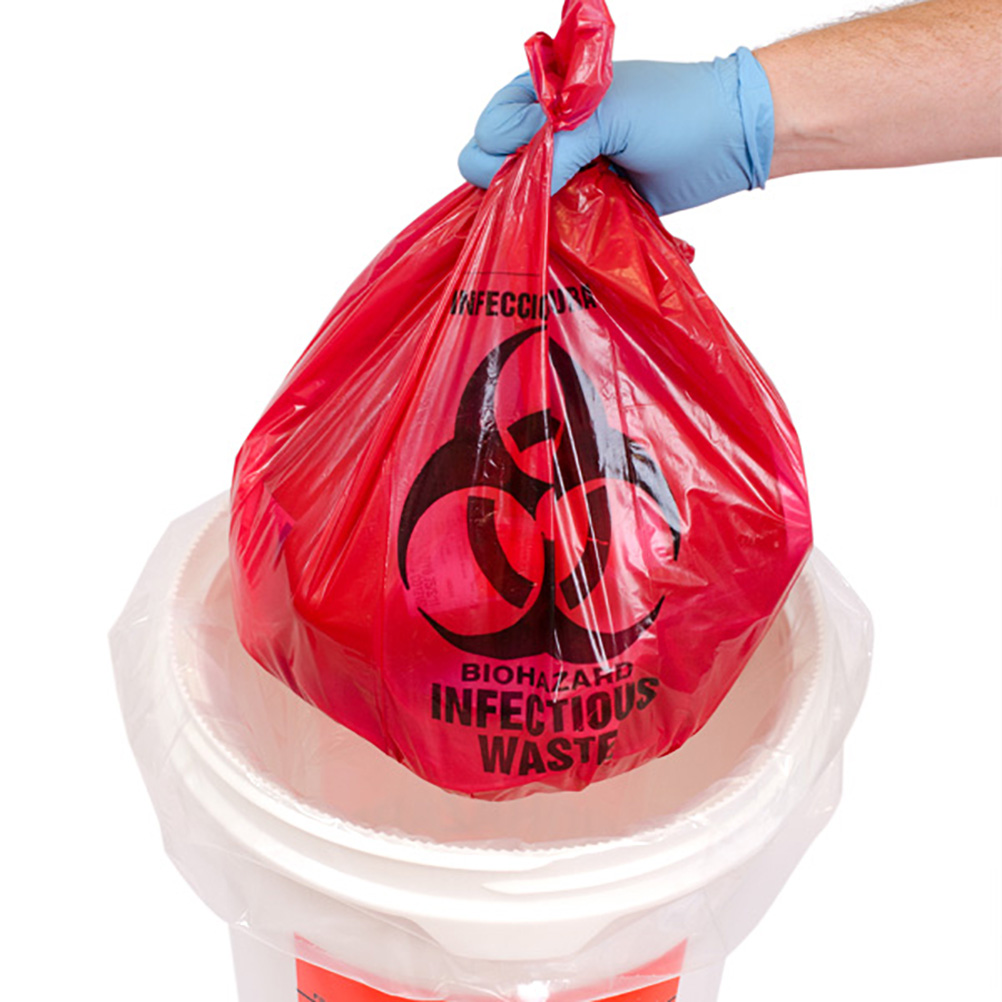
Decades after the Medical Waste Tracking Act prompted the passing of state medical waste regulations, red biohazard bags are still being filled with trash. Granted, we seldom see pizza boxes or drink cans in red bags anymore, but we still see trash, such as dressings, gauze, gloves, test strips, urine cups, empty medication vials, table and tray covers, device packaging, tubing, pads, and adults diapers. Proper waste segregation (RightClassification℠) is crucial to assure proper containment and disposal of trash, regulated medical waste (RMW), and hazardous waste. Many reasons are given as to why these items end up in red biohazard bags, including:
Medical waste becomes regulated when it contains enough blood or other potentially infectious materials (OPIM*) to potentially spread bloodborne pathogens. Therefore, if there is not enough contamination with blood OPIM, it is not a regulated medical waste. This definition has been taught to employees for over 20 years as a part of their bloodborne pathogens (BBP) training. Yet when it comes to putting this training into practice, it’s often as if the definition has never been heard. Occupational Safety and Health Administration (OSHA) defines RMW in its BBP Standard as follows:
Note: Urine and feces, among other body fluids not listed above, are NOT OPIM, and therefore, items contaminated with any amount of these body fluids do not carry enough BBP to be considered RMW.
In spite of the definition of RMW, some facilities still believe they must dispose of all items that have been merely “contaminated” with blood or OPIM as RMW, regardless of the amount of contamination. OSHA and state and local regulations do not require this. OSHA uses the term “contaminated” or “potentially contaminated” to refer to anything that has or could have any amount of blood or OPIM on it. “Contaminated” is NOT necessarily the same as “regulated.” Items that are simply contaminated with small absorbed amounts of blood or OPIM may be placed in a regular plastic-lined trash container.
In order for inspectors to interpret the regulations as intended, OSHA provides compliance directives for its standards. The current federal compliance directive for the BBP Standard is CPL 02-02-069.
Taken directly from CPL 02-02-069: “The compliance officer should not use the actual volume of blood to determine whether or not a particular material is to be considered regulated waste, since 10 ml of blood on a disposable bed sheet would appear as a spot (not regulated waste) while the same amount of blood on a cotton ball would likely cause saturation and dripping (regulated waste). Instead, the compliance officer should consider the potential for generation of bulk blood (i.e., through dripping or flaking off of material that may contain either blood or OPIM). Note: employees must handle items contaminated with ANY amount of blood or OPIM using Universal Precautions; the definition of regulated medical waste refers to how much blood or OPIM that item contains in order to decide if it should be discarded in the regular plastic-lined trash container, or the red-bag lined regulated medical waste container.”
Part 2 of this series will talk about state disposal regulations and how to properly segregate, contain, and dispose of RMW. Part 3 will discuss how to reduce medical waste through RightClassification.
For more information on Sharps Compliance’s medical waste solutions, click here.