


No. Georgia measures medical waste volume at each address, so a busy Atlanta suite and a two-room satellite can sit on opposite sides of the threshold while running one shared program.
Some Popular searches:
Some Popular searches:
Sharps Medical Waste Services collects, transports, and disposes of regulated medical waste for healthcare practices across Atlanta, from the hospital corridor in the 30342 ZIP code to the Perimeter offices in 30328 ZIP code. The same program covers medical waste disposal across Georgia.
Most healthcare organizations in this corner of Fulton County run several addresses. A procedural suite near Johnson Ferry Road might fill a container in a week. A satellite office fills one in a quarter. Georgia measures each address on its own, so one organization can hold two positions on paper while needing a single answer at an inspection.
Sharps MWS sizes service to each site and keeps one record set across every address. Pricing is matched to the site. A satellite is not priced like a hospital, and no site pays for capacity it does not use.

Georgia holds the practice that produces medical waste responsible for how it is handled, stored, and documented. Size does not change that. The state calls the material “biomedical waste” and the Environmental Protection Division administers the rule.
Volume decides how much of the rule applies. A site producing 100 pounds or more per month falls under the full requirement. Below that line, a partial exemption applies. That exemption is not the same as no obligation, and it is measured at the address, not the organization. Georgia rules reach any business that produces medical waste, which the state calls a generator.
Sharps MWS collects and transports biomedical waste in Georgia under Environmental Protection Division permit-by-rule PBR-160-99COL-BIO. Waste leaves your Atlanta site under a documented chain of custody, and every pickup produces a record of what was picked up and when. That record is what most practices find missing at an inspection, and our compliance support for healthcare practices covers what Georgia expects.
Not every sharps injury happens during the procedure. Some happen at the container. When a container reaches its fill line in the middle of a busy day, the next person still has a needle to dispose of, and forcing it past a full opening is where the risk sits. In a high-volume Atlanta procedural suite, that moment arrives sooner than the schedule expects, which is why container size and frequency matter as much as the container itself.
Container selection is not a cabinet decision. Sharps MWS matches size and placement to what each room produces, then collects on a schedule built around that volume. Classification also controls cost. When ordinary waste goes into a red bag, you pay treatment rates for ordinary trash, which is a failure in the other direction.
The generator holds legal responsibility for the waste until it is treated and its destruction documented.
Your staff is focused on patients. Sharps MWS keeps the container program sized, safe, and documented under OSHA’s Bloodborne Pathogens Standard.
Sharps MWS collects across Fulton County, from the 30342 ZIP code on the Johnson Ferry ridge down to Sandy Springs in 30328. Routes also reach:
Practices northeast in Suwanee are covered on their own route.
The 30342 corridor is anchored by three hospital campuses: Northside Hospital Atlanta, Emory Saint Joseph’s Hospital, and Children’s Healthcare of Atlanta at Scottish Rite. Procedural suites and infusion sites cluster around them. Sharps MWS serves hospitals and health systems, outpatient infusion and dialysis sites, and the smaller practices sharing their buildings.
We offer several services for the facilities in Atlanta, GA.

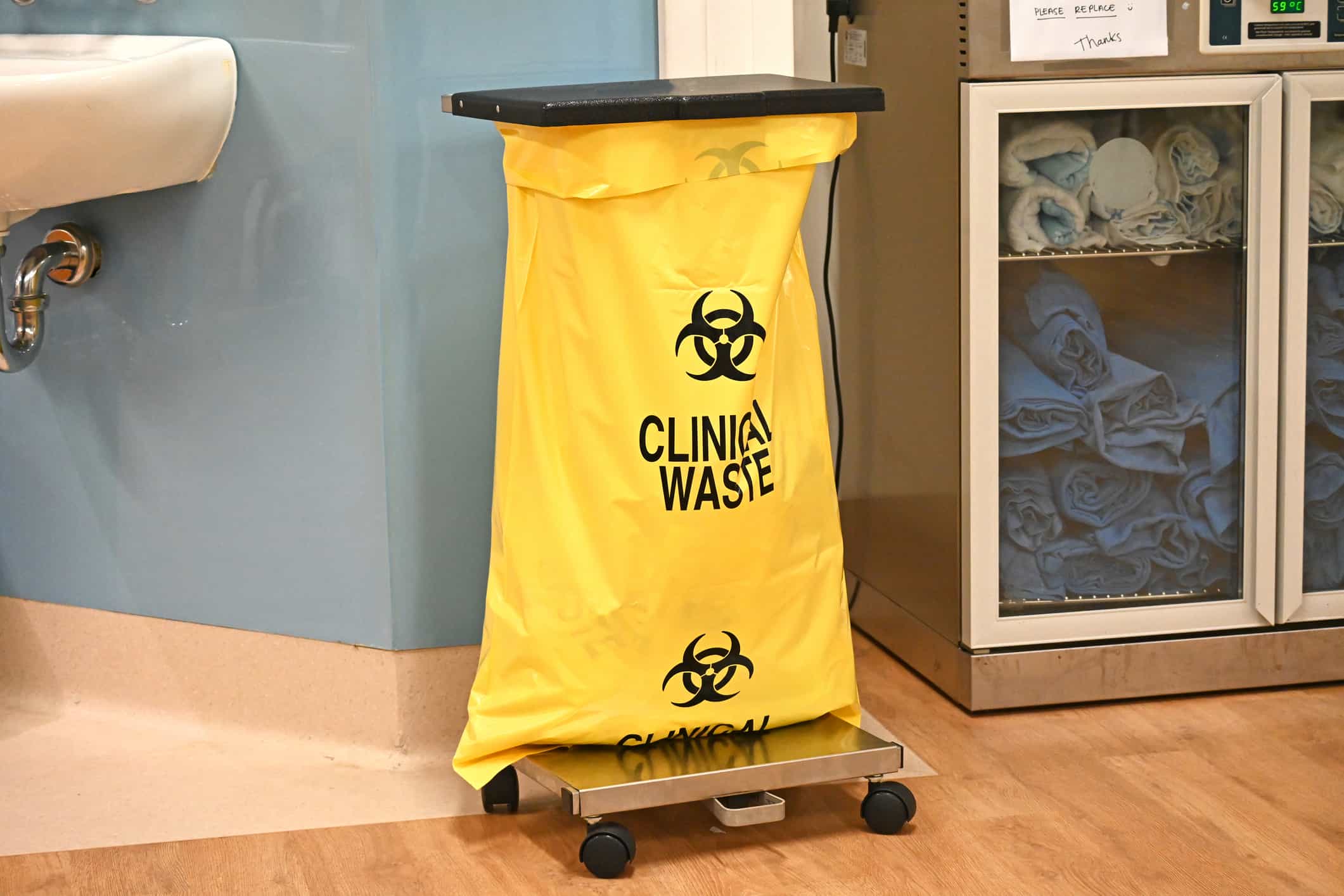
Red bag waste and contaminated single-use items are collected on a schedule set by each Atlanta site. Containers come with the service, and volumes are reviewed as a practice adds rooms.

Puncture-resistant containers are placed where sharps are used, then exchanged before they reach the fill line. Sizes are matched room by room rather than standardized across a building.

Trace chemotherapy waste and pathology specimens are separated from red bag waste at the point of use and collected as their own stream, as Atlanta oncology and surgical practices require.

Expired stock, partial vials, and patient returns are collected apart from medical waste. Sites with an on-site pharmacy get a stream that accounts for both hazardous and non-hazardous medication.

Prepaid mailback is a choice, not a fallback. It carries no contract, ships on your schedule, and suits satellite offices and smaller practices that do not want a route built around them.

Staff turnover is the usual reason a working program drifts. Training covers segregation, packaging, and what each Atlanta site must document, so the answer is the same at every address.
Georgia’s biomedical waste rules are published by the Georgia Environmental Protection Division, part of the Department of Natural Resources and the agency to check for current requirements. For the distinction Atlanta practices ask about most, see hazardous versus biohazardous waste.
No. Georgia measures medical waste volume at each address, so a busy Atlanta suite and a two-room satellite can sit on opposite sides of the threshold while running one shared program.
No. Georgia requires compliant collection and documented disposal, not a particular service model. Prepaid mailback carries no contract and suits low or irregular volume. Sharps MWS serves Atlanta practices either way.
Georgia does not permit chemotherapy waste to be steam-decontaminated. Atlanta oncology and infusion sites separate it at the point of use, and Sharps MWS collects it as its own stream.
No. Flushing fails the DEA non-retrievable standard set by its 2014 Final Rule. Sharps MWS holds DEA reverse distributor registration RS0365800 and collects controlled substance waste under it.
Each address is priced on the service it uses. A satellite that fills one container a quarter is not billed like a suite on a weekly route, and unused capacity is not charged.

Discover a simpler way to manage medical waste. Sharps MWS offers national coverage, tailored solutions, and proven results. If you are evaluating your current provider, preparing for an inspection, or managing multiple Atlanta-area sites, we can review your program and identify where cost and risk are misaligned.